
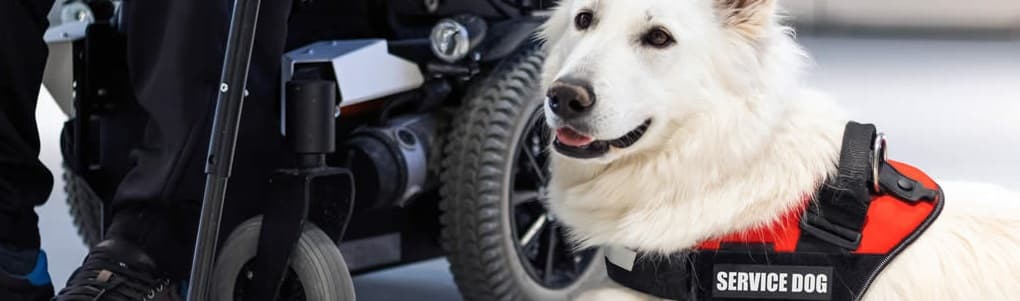
Over recent years, there have been many changes to the rights and protections offered to animals who serve both the disabled and those who are under medical stress, no matter what the age or condition of the person. Service, emotional support, and therapy animals all offer assistance to those who are in need of it in different ways. Protections for these animals vary greatly, however, and it is important to understand the regulations involved in flying with a service dog, emotional support or therapy animal.
What is a Service Dog?
Service animals are defined by the Americans with Disabilities Act as “a dog that is individually trained to do work or perform tasks for a person with a disability.” This act is enforced by many agencies in the United States, and airlines around the world have also adopted this definition of a service dog in their airline pet policies.
Title II and III of this act state that service dogs must be permitted into any privately owned business in the United States that serves the public, such as restaurants, hotels, retail stores, taxicabs, theaters, concert halls, sports facilities, and government buildings. Private business owners are prohibited from discriminating against individuals with disabilities, as are commercial airlines.
Note that it is legal to ask whether the dog is required due to a disability and what task the dog provides.
The government agency that administers laws that affect all types of transportation is the Department of Transportation (DOT). This agency aligned its definition of a service animal through an amendment to their regulation 14 CFR Part 382 (Part 382) to “a dog that individually trained to do work or perform tasks for the benefit of a qualified individual with a disability, including a
physical, sensory, psychiatric, intellectual, or other mental disability.”
Under this amendment, service dogs must perform at least one of the daily functions and tasks that an individual with a disability cannot perform for themselves.
“Seeing eye dogs” are one type of service animal, used by some individuals who are blind. Most people are most familiar with this type of service animal. That said, there are service animals that assist people with other kinds of disabilities in their day-to-day activities. Some examples include:
- Alerting people with hearing impairments to sounds or signals.
- Guiding individuals with visual impairments.
- Pulling wheelchairs or carrying and picking up things for people with mobility impairments.
- Assisting people with mobility impairments with balance.
- Informing people with diabetes about fluctuations in their blood sugar levels.
- Alerting people as to the onset of seizures.
- Reminding individuals with memory loss to take their medication.
- Initiating emergency calls in critical situations.
Flying with a Service Dog
Service dogs that are flying with a disabled passenger on commercial airlines are also protected under the Air Carrier Access Act (ACAA). All airlines that originate or terminate flights in the United States are subject to the regulations in this act.
Because they are trained to provide services that help those with physical disabilities, service dogs may accompany the people they serve in places where other animals would not be permitted, such as in the cabin of an aircraft. This applies even when they exceed normal carry-on requirements. As they are not classified as “pets,” they are not subject to airline pet policies.
In every case, they are eligible to fly without incurring any charges. They should be identified as a service dog (usually via a harness) and leashed as well. They are expected to fly at the feet of the disabled passenger.
Additionally, airlines cannot refuse to fly service dogs onboard because they make other passengers or flight crew uncomfortable. This includes passengers with allergies. If a service dog interferes with cabin operations, however, the airlines must make special arrangements in the cabin or fly service dogs in the cargo hold.
Airline pet policies for US-based airlines or those originating from or terminating in the US are basically similar because these airlines are subject to ADA, ACAA, and DOT regulations.
Passengers intending to travel to countries requiring that their pet arrive as air cargo (United Kingdom, Hong Kong, Australia, New Zealand, etc.) must make arrangements for a veterinary inspector to meet them at the aircraft when they land.
Documentation Required
We would note that a service dog (referred to as an assistance dog) must be certified by either the International Guide Dog Federation (IGDF) or Assistance Dogs International (ADI) to qualify for most European-based airlines. Most airlines will accept documentation from nationally-recognized organizations.
All airlines will require that passengers flying with a service dog provide a minimum of 48 hours of notice before departure. US-based airlines are requiring behavioral, sanitation, veterinary health, and liability forms to be completed and submitted at their websites prior to travel.
The disabled passenger must fly with the service dog.
What is Expected of a Service Dog?
All dogs providing assistance to their owners must behave properly around other people or animals. When flying, they must not impede cabin operations, and their size must allow them to fly without affecting other passengers.
Service dogs must be socialized, be mannerly, and show no signs of aggression to other passengers or cabin crew.
Service dogs must be trained to perform an identifiable and necessary task for their handlers. They should provide this service consistently and not be distracted by activity around them.
Service dogs must be friendly, have an even nature, and remain calm and focused on serving their disabled passengers.
What is an Emotional Support or Comfort Animal?
Emotional support or comfort animals are pets that provide support for their owners for mental disabilities defined in the Diagnostic and Statistical Manual of Mental Disorders. Research suggests that people with psychiatric disabilities can benefit significantly from comfort animals. ESAs have been proven extremely effective at addressing the symptoms of these disabilities, such as depression and post-traumatic stress disorder, by providing therapeutic nurture and support.
Flying with an Emotional Support Animal
An emotional support animal (ESA) no longer qualifies for protection under the Air Carrier Access Act (ACAA). ESAs must fly under airline policies covering all animals. However, if their owner can provide certification from a treating licensed medical professional that their dog is trained to perform a task that is necessary for the owner’s benefit, the airline can consider accepting the dog as a service dog. In these cases, the decision is up to the discretion of the airlines.
All of the characteristics listed above must be followed to qualify an emotional support dog as a service dog. Pet owners should closely evaluate the personality of their dog and the ability to perform a specific task when classifying their dog as a service dog.
Related: more information on what you should consider when selecting a dog to be an emotional support animal.
Foreign-flagged airlines differ in their policies on ESAs. Volaris and LATAM will allow ESA pets on specific routes. Others such as British Airways do not recognize ESA status on any of their flights. Other foreign carriers may also follow the ESA pet policies, but they
are not obligated to do so if their flight does not involve airports in the United States.
What is a Therapy Animal?
Therapy animals are used in Animal Assisted Therapy to improve the physical, social, emotional, and cognitive condition of the patient. A therapy animal is generally a dog that has been obedience-trained and screened for its ability to interact favorably with humans and other animals; however, cats and other animals have proven to be effective therapy animals. The primary purpose of a therapy dog is to visit people in hospitals, care homes, and retirement centers who enjoy being visited by a friendly pet. They are generally handled by volunteers who both train the animals and then take them on visits.
Flying with a Therapy Animal
Therapy animals are not protected by the ACAA and, as such, are subject to regulations imposed on all animals flying under airline pet policies.
Service Animals in Training
Service animals being trained to assist people with disabilities are not under ADA protection until their training is complete. Some airlines, such as KLM and Allegiant, will accept service animals in training if they are traveling with their trainer and the
trainer must provide a letter written on the training school’s letterhead stating that “the animal is training to assist a person
with a disability.” Animals being transported to their new owner without a trainer do not qualify for ACAA protection.
In short, only service dogs are provided protection when flying commercially. When flying with emotional support and therapy animals, airline pet policies for all animals on the aircraft will preside.
Have a comment about flying with a service dog? Post it below and be published! You can also reach out by posting to our Blog, X (Twitter), Facebook, or Email or follow our activities on Instagram and TikTok.


Leave a Reply